— Men's capsule wardrobe in your 30s · 25 pieces · Investment edit · Updated May 2026
Men's capsule wardrobe in your 30s.
Your 30s are when clothes stop being a burden and start being a statement. You know what fits. You know what you'll actually wear. The capsule in your 30s isn't about covering the bases — it's about investing in fewer, better things that compound over time.
Every piece photorealistic on your body
1 free try-on · no signup, no card.
What changes in your 30s
The capsule logic doesn't change — fewer pieces, all combining, neutral palette. What changes is your relationship to quality: you have the income to buy correctly, the experience to know what works, and the occasions that demand it. The four shifts below define what separates a 30s capsule from a 20s one.
Budget relaxes — but discipline matters more
You earn more in your 30s. You also risk buying more. The capsule in your 30s isn't about scarcity — it's about the discipline to buy one excellent blazer instead of three mediocre ones. The men who end their 30s with a strong wardrobe are the ones who spent on fewer, better things and resisted the lifestyle-inflation temptation to fill the closet.
Quality replaces price as the decision criterion
In your 20s, the question was 'what can I afford?' In your 30s, the right question is 'what's the best version of this that I'll still own in 10 years?' That reframe changes every purchase. A $400 Italian-cotton blazer from Boglioli is a better 10-year decision than a $120 polyester version from a fast-fashion brand — not because of the label, but because the fabric, the construction, and the silhouette are genuinely different.
The occasions multiply
Weddings (as a guest, as a groomsman, possibly as the groom). Client dinners. Weekend trips. A long weekend in a European city. A first-anniversary dinner. Funerals. Garden parties. The 20s capsule was built for daily life plus occasional formality. The 30s capsule has to handle the full range — and the investment tier pieces (the overcoat, the suede Chelseas, the cashmere V-neck) are what close the gap.
Your silhouette is fixed — you know what fits
By 30, most men know their body. They know if slim-straight works or straight-cut is better. They know if they're a 38R or 40R. They know which waistbands sit at the right rise. That knowledge is worth money — you stop buying the wrong silhouette by accident. This is the decade when bespoke or made-to-measure becomes worth considering for blazers and trousers.
The 25-piece 30s capsule
4 tailoring · 7 tops · 2 denim/trousers · 4 outerwear · 5 footwear · 3 accessories
Tailoring
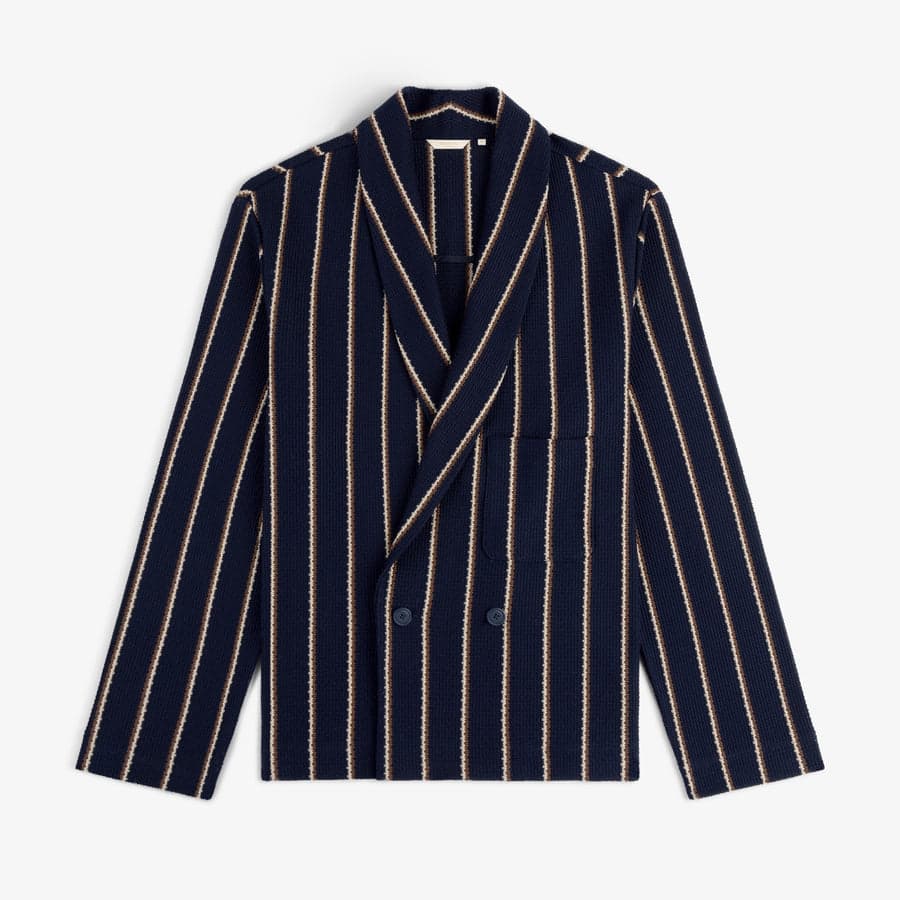
Navy unstructured blazer$400–700
Boglioli, COS, or SuitSupply
Italian cotton or wool-linen. Unstructured shoulder — it should feel like wearing a shirt, not armour. The single highest-leverage piece in any 30s wardrobe.
Charcoal wool trousers$200–400
SuitSupply or Reiss
Pleated or flat front — both work if the cut is clean. Mid-weight worsted wool, slim taper, quarter-break at the shoe.
Mid-grey flannel trousers$200–350
SuitSupply or Drake's
Winter rotation partner for the charcoal. Flannel drapes beautifully and wears warmer — pair with the cashmere crewneck.
Camel chinos (lightweight cotton)$180–300
Incotex or similar
This tier of chino is a different object from the Uniqlo version — the fabric weight and drape change the silhouette entirely. Worth the upgrade in your 30s.
Tops
White poplin OCBD$120–200
Drake's or Thomas Mason
The upgrade from the 20s Oxford. Finer poplin or pinpoint weave, properly fitted. Side-seam darts, no excess fabric at the waist.
Light blue spread-collar shirt$120–200
Drake's or similar
A second shirt colour for variety. Spread collar works open under blazers; buttoned up under a V-neck for a clean layered look.
White heavyweight T-shirt$50–80
Buck Mason or ALD
The foundation T upgraded. Same Supima weight as your 20s version — buy a better brand that fits your body specifically.
Grey heavyweight T-shirt$50–80
Buck Mason or ALD
The neutral complement to the white. Heather grey reads softer; charcoal grey reads more deliberate. Either works.
Black merino turtleneck$200–350
John Smedley or similar
The single most upgraded one-piece outfit in a 30s wardrobe. Black turtleneck under the camel overcoat is complete.
Navy merino crewneck$200–400
John Smedley or Loro Piana
Merino in 14-gauge — substantial enough to wear alone, fine enough to layer under the blazer. Upgrade from the 20s version.
Cream cashmere V-neck$300–500
Uniqlo Premium Cashmere or similar
The investment knit. Cream or oatmeal works over both dark and light shirts. Cashmere at this gauge drapes differently — you'll know immediately why it costs more.
Denim & Trousers
Dark selvedge jeans$200–350
Japan Blue or Tanuki
The 30s upgrade from Levi's. Japanese selvedge denim in a slim-straight cut — same silhouette, better fabric, better fade over time.
Olive fatigue trousers$150–250
or quality military surplus
The casual utility trouser for weekends and travel. Tapered, not baggy — these should look deliberate, not military-surplus-random.
Outerwear
Camel wool overcoat$500–900
Crombie or Harris Wharf London
The 30s centrepiece. Pure wool or wool-cashmere blend; full-canvas or quality half-canvas construction. Buy the best one you can stretch to — it will last 15+ years.
Navy or grey Harrington jacket$200–350
Baracuta or similar
The casual outerwear upgrade from the denim jacket. Cotton-nylon shell, clean silhouette, wears over everything from T-shirts to OCBDs.
Brown suede or leather jacket$600–1,200
Schott NYC or similar
The statement outerwear piece. Brown suede reads more elegant than black leather; biker silhouette reads modern; flight jacket reads heritage. Buy one of these, not two of lesser quality.
Quilted gilet$150–300
Barbour or similar
Worn as a mid-layer between Oxford and overcoat. Sounds country — reads urbane in the right proportions. Keep it slim and short.
Footwear
Brown suede chelsea boots$300–500
Loake or R.M. Williams
The 30s boot upgrade. Goodyear-welted construction means they can be resoled — a $400 boot that lasts 10 years costs $40/year.
White leather sneakers$200–450
Common Projects or Veja
The upgrade from the 20s version. Common Projects' Achilles is the reference — minimal, full-grain leather, no branding. Expensive but lasts a decade.
Brown penny loafers (suede)$200–400
Carmina or Meermin
Sockless in summer with chinos or rolled jeans. Suede reads softer than leather; penny slot reads English country.
Black leather Derbies$250–450
Tricker's or Sanders
Goodyear-welted, open lacing, plain or cap toe. For the most formal end of the 30s occasion range — less stiff than Oxfords, still reads serious.
Tan suede desert boots$150–300
Clarks Originals or Sanders
The heritage casual shoe. Tan suede, crepe sole, slim toe. Wears with jeans and chinos in a way no other casual shoe does.
Accessories
Full-grain leather belt$80–150
any quality tannery
Match to the shoes, always. One brown, one black — or a single reversible if the rest of your capsule allows it.
Field or dress watch (38–40mm)$200–800
Hamilton Khaki, Oris, or Junghans
Slim case, leather strap or simple steel. A watch at 38–40mm reads clean on the wrist — not a statement, a detail.
Canvas or leather tote or weekender$200–500
Mismo or Frank Clegg
Replaces the 20s messenger bag. A structured weekender covers travel and gym; a canvas tote covers daily work and groceries.
The 30s upgrade strategy
Don't replace the 20s capsule — upgrade the top 5 pieces each year
The 20s foundation (white Oxford, dark jeans, navy chinos, grey sweatshirt, white T-shirt) still works in your 30s. Upgrade one or two anchor pieces per year rather than overhauling everything at once. A gradual upgrade reads more confident than a sudden change.
The blazer is the single biggest upgrade you can make
A quality unstructured navy blazer changes more outfits than any other purchase in a 30-something's wardrobe. Spend $300–600 on a single correct one — Italian construction, unlined or half-lined, wool or cotton — rather than $150 on something that reads fast-fashion from 10 feet.
Shoes return more value than any other upgrade
Goodyear-welted shoes (brown suede Chelseas, black Derbies, penny loafers) signal quality that people notice before they notice anything else. A $400 resoleable shoe costs $40/year; a $100 bonded-leather boot lasts 18 months and looks bad the whole time. Shoes are the 30s investment with the highest perception return.
Budget targets: mid ($3,000) / full investment ($5,500)
The mid-budget 30s capsule hits $3,000 and covers tailoring, quality knits, one pair of investment shoes, and the overcoat. The full capsule at $5,500 adds the suede or leather jacket, full footwear rotation, and complete accessory tier. Both are better value than $3,000 or $5,500 spread across fast-fashion impulse buys.
Get the 30s capsule PDF
25 pieces · Direct shopping links · Brand recommendations at mid and investment tiers.
No spam. Unsubscribe anytime.
Frequently asked questions
What should a man in his 30s have in his wardrobe?
The 30s wardrobe anchors on tailoring and investment fabrics: navy unstructured blazer, charcoal and grey flannel trousers, white and light blue shirts, navy and cream knits, dark selvedge jeans, camel chinos, camel wool overcoat. The key footwear: brown suede Chelseas, white leather sneakers, penny loafers, Derbies, desert boots. Accessories: watch, leather belt, weekender bag. That's 25 pieces covering every occasion from weekend grocery run to client dinner.
How is a 30s wardrobe different from a 20s wardrobe?
Four key shifts. First, quality replaces price as the decision criterion — you're asking 'is this the best version?' not 'can I afford this?' Second, tailoring enters the picture properly — an unstructured blazer and properly fitted trousers change how every outfit reads. Third, investment materials (selvedge denim, cashmere, Goodyear-welt shoes) become worth the premium because you actually have the occasions to wear them. Fourth, the capsule has to stretch further — more occasion types, more travel, more social contexts.
What are the best clothing investments for men in their 30s?
In order of return: 1) Goodyear-welted boots or shoes (brown suede Chelseas from Loake or R.M. Williams — they resole, so a $400 boot becomes $40/year). 2) Camel wool overcoat (visible from 30 feet away, transforms every outfit underneath). 3) Navy unstructured blazer (the single piece that raises every outfit average). 4) Cashmere or fine merino knitwear (the difference between a $50 sweater and a $300 one is immediately visible after 6 months of wearing). 5) One pair of Common Projects or equivalent sneakers.
Should I have a different wardrobe in my 30s than my 20s?
Qualitatively different, not categorically different. The same capsule logic applies — fewer pieces, all combining. What changes is the quality tier on every piece and the addition of proper tailoring. You don't need a different category of clothes in your 30s; you need better versions of the same categories. The exception is the outerwear tier: a quality wool overcoat and a suede or leather jacket are 30s purchases that most 20-somethings can't justify yet.
What's the first upgrade to make when building a 30s capsule?
The navy unstructured blazer. It's the highest-leverage piece in any 30-something wardrobe because it immediately elevates everything paired with it — dark jeans and an Oxford button-down becomes a dressed occasion; chinos and a white T-shirt becomes a casual-smart outfit. Buy an Italian cotton or unlined wool version from SuitSupply, COS, or Boglioli in the $300–600 range. One quality blazer changes more outfits than any other single purchase.